India-UK Free Trade Agreement 2025: A New Era in Bilateral Trade
Introduction
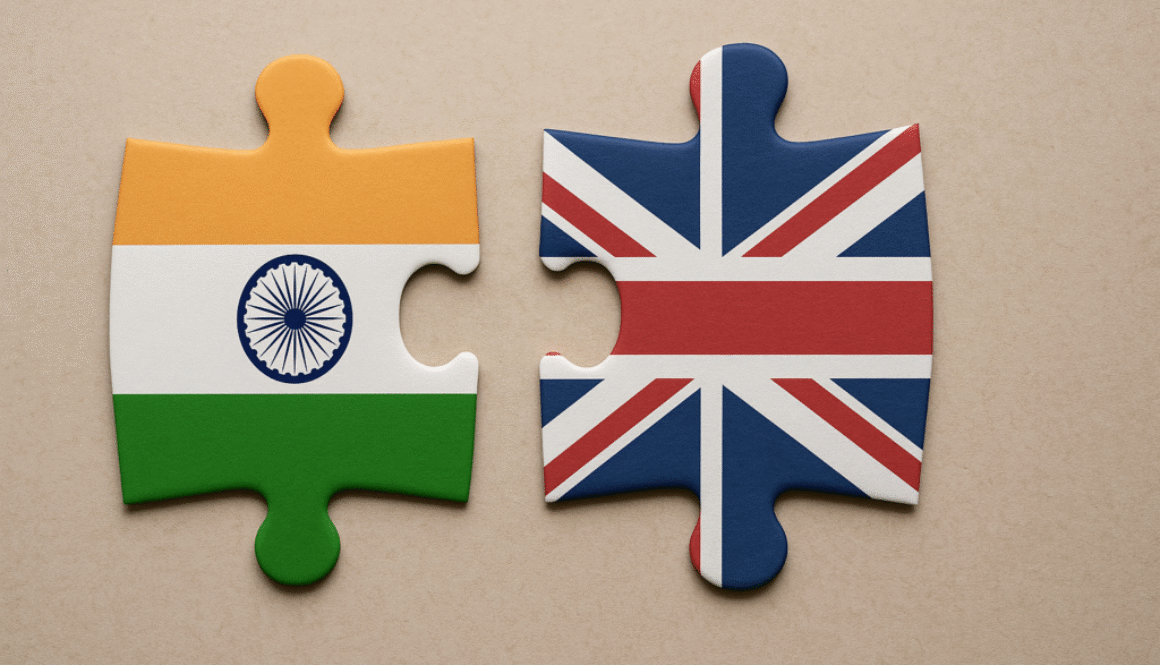
On July 24, 2025, during Prime Minister Narendra Modi’s visit to the UK, India and the United Kingdom signed the Comprehensive Economic and Trade Agreement (CETA), a landmark free trade agreement (FTA) aimed at doubling bilateral trade to $112 billion by 2030. Formalized by Commerce Minister Piyush Goyal and UK Business Secretary Jonathan Reynolds in the presence of PMs Modi and Keir Starmer, the deal marks India’s most comprehensive trade pact with a developed economy. CETA covers 26 sectors, from tariffs to technology. What are the origins of India-UK trade ties, why is this agreement significant, and how does it reshape global trade dynamics?
Origins and History of India-UK Trade Relations
India-UK economic ties trace back to colonial trade under the East India Company (1600–1858), with India exporting textiles and spices while importing British machinery. Post-independence, the 1966 India-UK Double Taxation Agreement fostered investment, with the UK becoming India’s third-largest investor by 2024 ($36 billion FDI). The 2004 Joint Economic and Trade Committee (JETCO) laid groundwork for deeper cooperation, followed by the 2010 Strategic Partnership, upgraded in 2021 as the India-UK Roadmap 2030, targeting $100 billion in trade. Bilateral trade grew from $16.6 billion in 2014 to $56 billion in 2024, with India exporting textiles ($4.2 billion) and gems ($1.8 billion), and the UK exporting machinery ($3.1 billion) and whisky ($1.2 billion).
FTA negotiations began in January 2022, driven by the UK’s post-Brexit (2020) pivot to non-EU partners and India’s exit from RCEP (2019) to avoid China-dominated trade. The 2021 Enhanced Trade Partnership (ETP) under Boris Johnson and Modi removed barriers like whisky tariffs (150% to 100%) and set FTA ambitions. After 14 rounds, talks stalled in 2024 over visas and social security for Indian workers, but the Labour government’s July 2024 election and 2024 G20 Rio Summit commitments relaunched negotiations. On May 6, 2025, Modi announced an agreement in principle, finalized on July 24, 2025, during his UK visit.
The CETA: Key Provisions and Procedural Details
CETA, signed on July 24, 2025, eliminates tariffs on 99% of Indian exports (e.g., textiles, seafood, gems) and 90% of UK exports (e.g., whisky, cars), covering 1,143 product categories. Whisky tariffs drop from 150% to 75%, then to 40% by 2035, benefiting Scotland’s $2 billion industry. Automotive tariffs fall from over 100% to 10% under quotas, aiding UK brands like Jaguar Land Rover. India gains duty-free access for marine products ($104 million in 2024), boosting shrimp exports by 70%. The deal includes 36 UK services sectors without economic needs tests and allows 1,800 Indian chefs and yoga trainers annually, alongside a Double Contributions Convention exempting short-term Indian workers from UK social security payments.
The agreement, spanning 27 chapters, addresses digital trade, intellectual property, and government procurement, granting UK firms access to India’s $38 billion tender market. A dispute settlement mechanism ensures fair enforcement, balancing state-to-state resolution with early dispute prevention. The India-UK Vision 2035, unveiled alongside CETA, replaces Roadmap 2030, emphasizing defense, climate, and AI collaboration. Legal texts await parliamentary ratification under the UK’s CRAG Act 2010, with India targeting implementation by October 2026. Ongoing Bilateral Investment Treaty (BIT) talks aim to protect $6 billion in mutual investments.
Broader Implications and Significance
CETA positions India as a counterweight to global trade disruptions, like US tariffs under Trump (April 2025), projecting a $34 billion annual trade boost by 2040. The UK’s GDP is estimated to grow by $6.4 billion annually, with India gaining 5% UK market share in textiles and engineering ($7.5 billion by 2030). India’s coastal economy, particularly seafood, benefits from tariff-free access, leveling the playing field with Vietnam. The deal aligns with India’s $1 trillion export goal by 2030, supporting labor-intensive sectors (textiles employ 45 million) and Make in India. The UK secures first-mover advantage in India’s $3.3 trillion economy, projected to be third-largest by 2028.
Strategically, CETA counters China’s regional influence, complementing India’s FTAs with Japan (2011) and EFTA (2024). Vision 2035’s focus on clean energy and AI builds on the 2024 Technology Security Initiative, fostering $3 million deals like Poweronics UK’s IGBT technology transfer. However, unresolved issues like the UK’s Carbon Border Adjustment Mechanism (CBAM) could impose costs on Indian exporters, with India threatening retaliation. The BIT’s delay risks investor confidence, given India’s 2023 Model BIT’s restrictive clauses.
Critical Evaluation: Is CETA Effective?
CETA’s tariff cuts promise economic gains: UK exports to India may rise 60% ($15.7 billion) by 2040, while India’s textiles and seafood gain competitiveness. Job creation in India’s labor-intensive sectors and UK’s manufacturing (2,200 jobs from $6 billion investments) supports growth. The social security exemption aids 300,000 Indian workers in the UK, though visa quotas were scaled back from India’s initial demands. The deal’s dispute mechanism ensures enforceability, critical for India’s 40% litigation rate in past FTAs.
However, challenges loom. The Global Trade Research Initiative notes limited gains for India, as 60% of its exports already faced low tariffs. The UK’s exclusion of legal services disappoints India’s $7 billion sector, and CBAM risks negating benefits for steel exporters. India’s smartphone sector, protected from tariff cuts, may face WTO scrutiny. Implementation delays, as seen in India-ASEAN FTA (2010), and India’s complex regulatory environment could hinder MSME benefits. Critics argue the UK benefits more, given India’s trade deficit ($8.4 billion in 2024).
Conclusion
The India-UK CETA, signed during Modi’s July 2025 visit, marks a historic step in bilateral trade, doubling commerce to $112 billion by 2030. Rooted in decades of economic ties, it navigates post-Brexit and RCEP dynamics, boosting jobs and innovation. While tariff cuts and strategic alignments promise growth, unresolved issues like CBAM and BIT delays demand vigilance. As India and the UK deepen their partnership via Vision 2035, CETA signals a resilient economic alliance, pivotal for global trade stability in a turbulent era.