Supreme Court Reviews Delhi Air Pollution Measures 2025: A Comprehensive Analysis
Introduction
On July 18, 2025, the Supreme Court directed the Commission for Air Quality Management (CAQM) to submit a compliance report on Delhi’s air pollution control measures, citing inadequate enforcement of Stage IV of the Graded Response Action Plan (GRAP) amid worsening Air Quality Index (AQI) levels. The bench, led by Justices Abhay S. Oka and Augustine George Masih, expressed concern over systemic failures in implementing restrictions like vehicle bans and construction halts. This ruling, part of the ongoing M.C. Mehta v. Union of India case since 1985, underscores India’s persistent struggle with air pollution. What are the origins of Delhi’s air crisis, why is judicial oversight critical, and how does this fit into the broader environmental framework?
Origins and History of Delhi’s Air Pollution Crisis
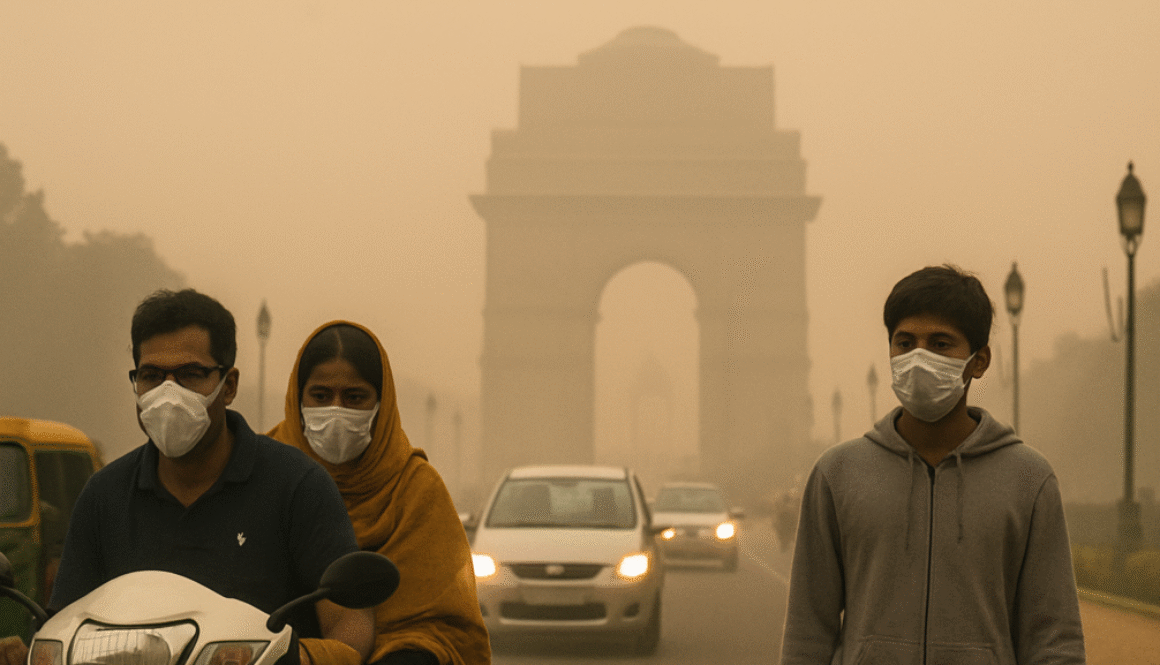
Delhi’s air pollution crisis, often dubbed a “public health emergency,” stems from a mix of vehicular emissions (36% of PM2.5 per a 2016 study), road dust (38%), industrial sources (11%), and seasonal stubble burning (up to 38% in November 2024). The city’s geography—landlocked, with low winter wind speeds—traps pollutants, exacerbating AQI levels, which hit 491 (“severe plus”) on November 18, 2024. The crisis traces back to rapid urbanization post-1990s economic liberalization, with Delhi’s vehicle count rising from 3.3 million in 2000 to 12 million by 2025. Industrial growth in the National Capital Region (NCR), coupled with lax regulation, worsened emissions. Stubble burning in Punjab and Haryana, driven by short cultivation cycles under laws like Punjab’s 2009 Subsoil Water Act, adds significant particulate matter.
The Supreme Court’s involvement began with the 1985 M.C. Mehta PIL, a landmark environmental case addressing industrial pollution. Key rulings include the 1998 shift to CNG for public transport, the 2018 Badarpur power plant closure, and the 2017 firecracker sale ban. The court’s 2023 suggestion to revise Punjab’s water act and its 2024 orders for NCR-wide firecracker bans reflect its proactive stance. The CAQM, formed in 2021 under the Air Quality Management Ordinance, coordinates NCR pollution control, but its efficacy is hampered by vacancies (55% in Delhi’s Pollution Control Committee in 2024) and poor coordination.
The Graded Response Action Plan (GRAP): Structure and Evolution
Introduced in 2017 by the Ministry of Environment, GRAP is a tiered framework to combat Delhi-NCR’s air pollution, escalating from Stage I (AQI 201–300, “poor”) to Stage IV (AQI >450, “severe plus”). Stage IV, invoked on November 18, 2024, bans non-essential truck entry, halts construction, and shifts schools online (except Classes 10 and 12). Earlier iterations, like the 2016 GRAP, lacked enforcement teeth, prompting Supreme Court interventions. In November 2024, the court criticized CAQM’s delay in activating Stage IV despite an AQI of 441, mandating its continuation even if AQI drops below 450. The July 2025 order builds on this, addressing non-compliance at Delhi’s 113 entry points, where only 13 were monitored, allowing unchecked vehicle entry.
Procedural Details and Judicial Oversight
The July 2025 hearing highlighted enforcement gaps. The court noted Delhi’s affidavit failed to detail monitoring at all entry points, with Justices Oka and Masih ordering immediate checkpost deployment. This follows a December 2024 directive for NCR states to ban firecrackers, with Rajasthan complying but Haryana and Uttar Pradesh lagging. The court also addressed labor welfare, ensuring ₹8,000 allowances for 90,000 construction workers affected by GRAP-IV bans, with 20,000 more registrations pending. In May 2025, the court ordered Delhi to fill 204 vacancies in its Pollution Control Committee by September 30, 2025, warning of contempt for non-compliance, as 55% vacancies crippled enforcement.
Broader Implications and Significance
Delhi’s air crisis, with AQI levels consistently exceeding 400 in winter, violates Article 21’s right to a clean environment. The Supreme Court’s role as a monitor, through the M.C. Mehta case, underscores judicial activism in environmental governance. GRAP’s measures—vehicle bans, construction halts, and online schooling—aim to protect vulnerable groups, but implementation failures, as noted in 2024–2025, highlight systemic issues. Stubble burning, contributing 38% to pollution in 2023, requires regional coordination, with the court urging ISRO data to track farm fires. The CAQM’s proposal to integrate GRAP-III measures (e.g., road sweeping) into Stage II reflects a shift toward proactive prevention.
This case illustrates the interplay of constitutional law (Article 21), environmental policy, and federalism. It also highlights India’s commitment to the 2015 Paris Agreement, targeting reduced emissions intensity, though urban pollution challenges persist. The court’s push for electric vehicles and better waste management (e.g., addressing 3,800 tonnes daily at Ghazipur landfill) aligns with the National Clean Air Programme (NCAP), which Delhi underutilized, spending only 30% of funds since 2019.
Critical Evaluation: Is the Approach Effective?
The Supreme Court’s oversight has driven progress, like CNG adoption and firecracker bans, reducing AQI peaks from 500+ in 2016 to 491 in 2024. However, inconsistent enforcement, as seen in GRAP-IV’s partial implementation, limits impact. Critics argue that judicial directives, while binding, cannot address root causes like vehicular growth or stubble burning without policy reform. The court’s focus on vacancies and funding aims for systemic fixes, but rural-urban disparities in enforcement and reliance on meteorological factors (e.g., wind speed) weaken outcomes. Supporters note that judicial pressure has spurred actions like the 2025 fuel ban for vehicles over 15 years, effective April 1, 2025.
Conclusion
The Supreme Court’s July 2025 directive to review Delhi’s air pollution measures reflects a 40-year quest to clean the capital’s air, rooted in the M.C. Mehta case. While GRAP and CAQM provide frameworks, enforcement gaps and regional disparities persist. For India to meet its environmental goals, coordinated action across NCR states, robust institutional capacity, and proactive policies are essential. This underscores the judiciary’s role in environmental governance and the complex balance of law, policy, and public health in tackling one of India’s gravest challenges.