Most philosophical systems begin by asking what the universe is made of or how reality is structured at its deepest level. Buddhist thought begins somewhere far more immediate: with how life feels when it is actually lived. It starts from a quiet but unsettling recognition, that even our happiest moments carry an undercurrent of instability. Pleasure fades, satisfaction slips, and peace rarely lasts. Buddhism names this condition duḥkha, often translated as “suffering,” though the term more accurately refers to a pervasive unease or dissatisfaction woven into ordinary experience. This recognition is not pessimistic but diagnostic. The Buddha’s project is not to deny joy or condemn life, but to understand why fulfilment so often fails to endure.
Saṃsāra as a Condition of Perception
To explain this persistent unease, Buddhism introduces the concept of saṃsāra. While commonly understood as a cycle of rebirth, saṃsāra is more fundamentally a way of perceiving and responding to the world. As Rupert Gethin explains in The Foundations of Buddhism (1998), saṃsāra refers to the ongoing mental process through which dissatisfaction is continuously generated, rather than merely to repeated lifetimes (pp. 61–64). Human consciousness, the Buddha observed, tends to project permanence onto what is fleeting and coherence onto what is unstable. We live as though things—relationships, achievements, even our own identities, ought to remain fixed. When they inevitably change, suffering follows. In this sense, saṃsāra names not a metaphysical trap but a habitual misreading of reality.
The Four Sights and the Collapse of Illusion
This misperception is first confronted in the narrative of Siddhārtha Gautama’s encounter with the Four Sights: old age, sickness, death, and a wandering ascetic. What unsettles Siddhārtha is not merely the biological fact of mortality, but the collapse of an entire worldview built on continuity and control. Peter Harvey notes in An Introduction to Buddhism: Teachings, History and Practices (2013) that these encounters “reveal the fragile, impermanent nature of existence” that had previously been concealed by comfort and privilege (pp. 17–19). The fourth sight, the serene figure of the muni, or contemplative—functions as a counter-image to this collapse. It suggests that while suffering may be unavoidable, one’s relationship to it is not. The problem and the possibility appear together: suffering exposes delusion, but also gestures toward a different way of seeing.
Duḥkha and the Logic of Craving
As Buddhist analysis deepens, suffering is no longer understood as a series of unfortunate events but as a structural feature of conditioned existence. Gethin describes duḥkha as an intrinsic “unsatisfactoriness” that arises whenever the mind seeks stability in what is inherently unstable (The Foundations of Buddhism, 1998, p. 61). The tension between how we expect the world to behave and how it actually behaves generates dissatisfaction. This tension is driven by tṛṣṇā, or craving, the impulse to grasp experiences, identities, and relationships as if they could secure us against impermanence. The tragedy of craving is that what it seeks cannot be held, because the self that desires permanence is itself unstable.
Non-Self and the Mistake of Identification
At this point, Buddhism introduces the radical doctrine of anātman, or non-self. Rather than denying existence, this teaching denies the existence of a fixed, independent core within the person. Harvey explains this through the doctrine of the five aggregates (skandhas): material form, sensation, perception, mental formations, and consciousness (An Introduction to Buddhism, 2013, pp. 55–56). Together, these processes generate the experience of being a person, but none of them remain the same from moment to moment. Craving arises when these dynamic processes are mistaken for a stable “I.” We cling to thoughts, emotions, and identities as if they were possessions, when in reality they are fleeting configurations. The self, in this sense, is not an object we have but an activity that unfolds.
Dependent Origination and the Mechanics of Suffering
This misrecognition initiates what Buddhist texts call dependent origination (pratītya-samutpāda). Rather than attributing suffering to fate or divine will, Buddhism presents it as the outcome of a chain of conditioned reactions. Ignorance gives rise to craving; craving leads to attachment; attachment reinforces the sense of self; and the cycle perpetuates itself. Gethin emphasizes that this teaching is radical because it shows suffering to be both caused and reversible (The Foundations of Buddhism, 1998, pp. 70–74). Saṃsāra is thus not a prison imposed from outside, but a process maintained by habitual patterns of attention. Liberation becomes possible when these patterns are understood and interrupted.
Awakening under the Bodhi Tree
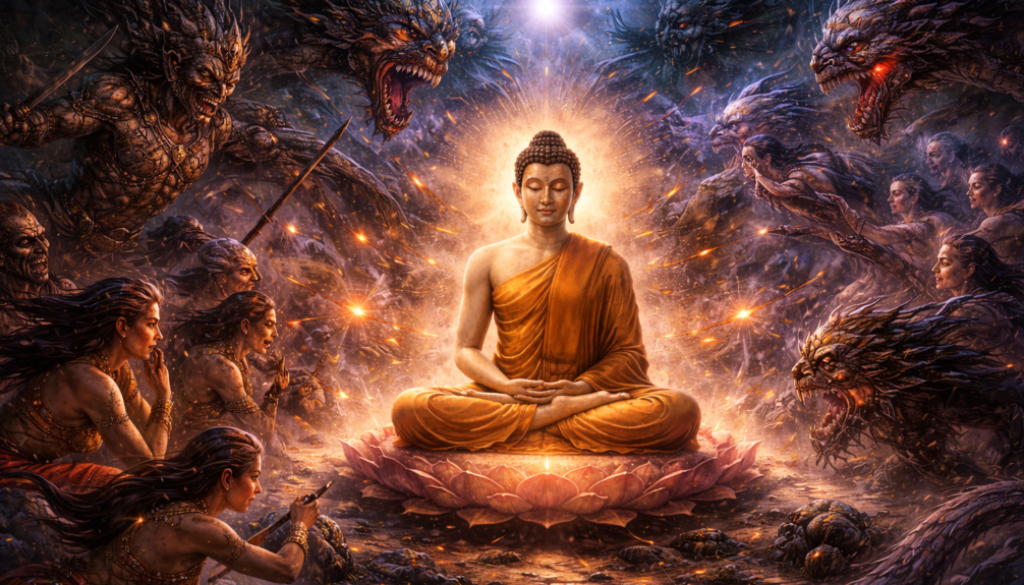
The Buddha’s awakening beneath the Bodhi tree dramatizes this insight with symbolic clarity. Māra’s attacks; fear, temptation, doubt, and pride—are not external enemies but manifestations of the mind’s own reactive tendencies. Harvey notes that the Buddha’s final realization involves a direct, experiential seeing of reality “as it truly is,” free from distortion (An Introduction to Buddhism, 2013, pp. 20–23). This perception of tathatā, or suchness, marks a profound shift. When craving is recognized as a conditioned reaction rather than a command to be obeyed, its force dissolves. Nirvāṇa is described as “extinguishing” because the restless fire of craving that sustains suffering finally burns out.
The Four Noble Truths as a Path of Transformation
Only after this experiential breakthrough does the Buddha articulate the Four Noble Truths. Their structure resembles a medical model, diagnosis, cause, cure, and treatment, as Gethin observes (The Foundations of Buddhism, 1998, p. 59). Yet each truth also entails an existential task: suffering must be understood, craving abandoned, cessation realized, and the path cultivated. The Eightfold Path is therefore not a belief system but a discipline of transformation. Ethical conduct calms destructive action, meditation stabilizes attention, and wisdom dismantles ignorance at its root. The path trains perception as much as behaviour.
Biography as Doctrine in Motion
This is why the Buddha’s life story is indispensable for understanding the Dharma. The narrative does not merely illustrate doctrine; it enacts it. The Four Sights destabilize delusion, renunciation embodies the shift from reactive life to contemplative awareness, awakening interrupts dependent origination, and the First Sermon transforms personal insight into a shared path. Stories such as that of Kisa Gotamī, who realizes that no household has been untouched by death, repeat this same perceptual shift. She does not merely learn a proposition; she undergoes a transformation in how she sees the world.
Seeing Clearly, Living Freely
To read the Buddha’s biography alongside Buddhist doctrine is to encounter the Dharma not as an abstract philosophy but as a lived discovery. Saṃsāra is generated through habitual grasping; liberation unfolds when those habits are understood and released. The Buddha’s life records the moment when a human being came to see this process with unclouded clarity, and in doing so, opened a path for others to follow, not as belief, but as practice.