Introduction
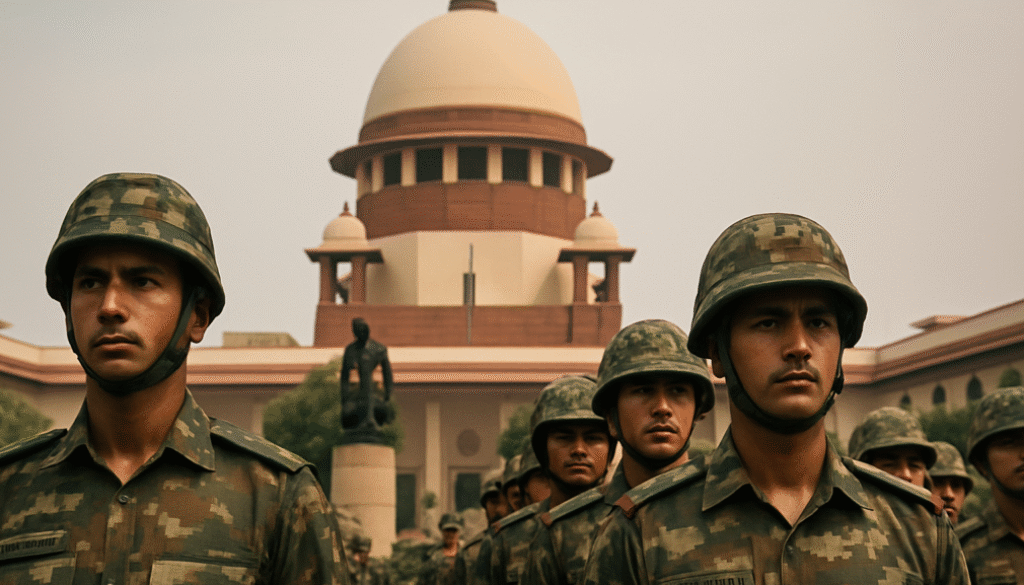
On July 18, 2025, the Supreme Court dismissed a Public Interest Litigation (PIL) seeking to halt the Agnipath Scheme, a transformative military recruitment policy introduced by the Government of India in June 2022. The court, led by Chief Justice Sanjiv Khanna, upheld the scheme’s constitutional validity, emphasizing its alignment with national security and public interest, while urging better implementation to address youth concerns. This follows earlier rulings in April 2023, where the court similarly rejected challenges to the scheme’s validity, reinforcing the Delhi High Court’s February 2023 judgment. What is the Agnipath Scheme, why has it sparked debate, and how does it fit into India’s military and socio-economic landscape?
Origins and Background of the Agnipath Scheme
The Agnipath Scheme, announced on June 14, 2022, revolutionized recruitment for India’s armed forces—Army, Navy, and Air Force—by introducing a short-term, merit-based model. Unlike the traditional system, where soldiers served 15–20 years with lifelong pensions, Agnipath recruits youths aged 17.5–21 (extended to 23 in 2022 due to COVID-19 recruitment halts) as “Agniveers” for a four-year tenure. Only 25% are retained for 15 additional years, while the rest receive a lump-sum “Seva Nidhi” package (₹11.71 lakh in 2022) and skill certificates to aid post-service employment. The scheme’s origins trace to a 2020 “Tour of Duty” proposal, tested with 100 officers and 1,000 soldiers, aimed at addressing personnel shortages (50,000–60,000 annual retirements from 2019–2021) and escalating pension costs (26% of defense expenditure by 2020–21, up from 19% in 2010–11). Named after Harivansh Rai Bachchan’s poem and a 1990 film, Agnipath reflects a vision of youthful, agile forces.
The scheme emerged from a strategic need to lower the average age of soldiers (32 to 26 years) and enhance combat readiness amid evolving warfare, including cyber and drone threats, as demonstrated by 3,000 Agniveers defending borders during the 2025 India-Pakistan conflict (Operation Sindoor). The government, backed by National Security Advisor Ajit Doval, framed it as a response to global trends, with countries like Israel and China adopting similar short-term conscription models. However, its abrupt rollout, bypassing parliamentary approval, sparked protests in 2022, with violent demonstrations in Bihar and Uttar Pradesh over job security concerns.
Legal Challenges and Judicial Rulings
The Agnipath Scheme faced immediate legal scrutiny. In June 2022, advocate M.L. Sharma filed a PIL in the Supreme Court, calling the scheme “illegal” and “unconstitutional” for lacking parliamentary sanction and disrupting century-old recruitment processes. Other petitions, including one by Harsh Ajay Singh, sought to protect candidates shortlisted under pre-Agnipath systems, citing delays due to COVID-19. In July 2022, the Supreme Court transferred these cases to the Delhi High Court for consolidated review, noting that fragmented litigation was “neither desirable nor proper.”
On February 27, 2023, the Delhi High Court, led by Chief Justice Satish Chandra Sharma, upheld Agnipath’s constitutional validity, calling it a “well-thought-out policy” in the national interest. The court dismissed claims of arbitrariness, emphasizing the scheme’s goal to create a youthful, agile force with a better “leader-to-led” ratio (from 1.1 to 1.28). It also rejected arguments of promissory estoppel, stating candidates had no vested right to appointments from prior recruitment drives.
In April 2023, the Supreme Court, under Chief Justice D.Y. Chandrachud, dismissed two pleas challenging the Delhi High Court’s verdict, affirming that public interest outweighed individual claims. A third plea concerning Indian Air Force (IAF) recruitment was heard separately but yielded no relief. The July 2025 ruling reiterated this stance, with the court acknowledging implementation challenges (e.g., training adequacy, job placement for exiting Agniveers) but refusing to halt the scheme. Instead, it urged the government to address youth concerns, such as skill certification efficacy and post-service opportunities.
Significance and Broader Implications
The Agnipath Scheme addresses critical fiscal and operational challenges. Defense pensions, exacerbated by the One Rank One Pension (OROP) scheme (2015), strained budgets, limiting modernization funds. Agnipath reduces long-term liabilities by limiting pensions to 25% of recruits, freeing resources for advanced weaponry and cyber-defense. It also aligns with global military trends, fostering a tech-savvy, youthful force to counter modern threats, as seen in Operation Sindoor. The scheme’s skill development component aims to prepare 75% of Agniveers for civilian jobs, potentially reducing unemployment among India’s 600 million youth (15–29 age group).
However, the scheme’s short tenure raises concerns about combat readiness. Critics, including opposition leaders like Mallikarjun Kharge, argue that six months of training (versus 3–5 years traditionally) produces “half-baked” soldiers, risking operational efficacy. Protests in 2022 highlighted fears of job insecurity, with detractors warning that trained Agniveers could be recruited by non-state actors like Maoists. The scheme’s voluntary nature, unlike mandatory conscription in Israel, limits its scale, with only 45,000–50,000 annual recruits against a 1.4-million-strong force.
Agnipath underscores tensions between national security, fiscal policy, and social equity. It reflects India’s push for self-reliance (Atmanirbhar Bharat) in defense while navigating youth unemployment (7.8% in 2024). The judiciary’s deference to executive policy highlights the limits of judicial review in national security matters, a key constitutional law topic.
Critical Evaluation: Is Agnipath Useful?
The scheme’s merits lie in its fiscal prudence and modernization goals. By reducing pension burdens, it frees up to ₹1.5 lakh crore annually for defense upgrades, critical amid border tensions with China and Pakistan. Its focus on youth aligns with India’s demographic dividend, potentially creating a pipeline of skilled workers for industries like logistics and cybersecurity. The 2025 India-Pakistan conflict demonstrated Agniveers’ operational value, with 3,000 contributing to drone defense.
Yet, challenges persist. The short tenure may compromise unit cohesion, as noted by defense experts, and the lack of guaranteed re-employment for 75% of Agniveers risks social discontent. Rural youth, comprising 60% of recruits, face barriers accessing skill programs, limiting the scheme’s inclusion goals. Critics also question its timing, arguing that COVID-era recruitment halts (2019–2021) unfairly disadvantaged pre-Agnipath aspirants. The Supreme Court’s call for better implementation signals these gaps, urging robust skilling and job placement frameworks.
Conclusion
The Supreme Court’s July 2025 ruling reaffirms Agnipath’s role in reshaping India’s armed forces, balancing fiscal sustainability with national security. While its youthful focus and cost-saving measures are forward-thinking, concerns over training, job security, and social impact demand attention. As Agnipath evolves, its success hinges on addressing these challenges, ensuring India’s military remains agile while supporting its youth. This case encapsulates the interplay of policy, law, and socio-economic dynamics, making it a critical study in governance and defense reforms.