Introduction
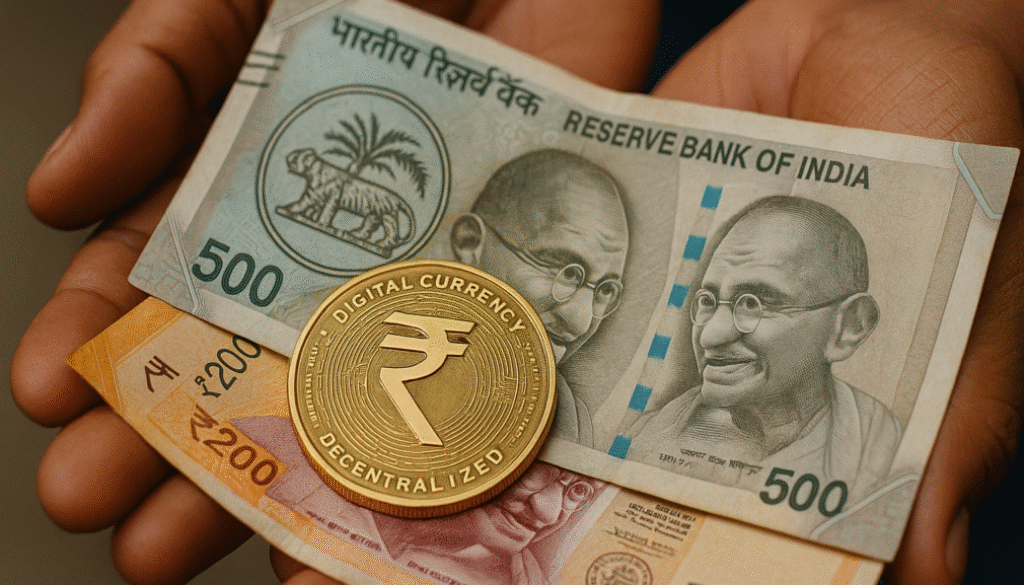
On July 13, 2025, the Reserve Bank of India (RBI) announced plans to expand its Central Bank Digital Currency (CBDC) pilot, the e-Rupee, targeting 1 million users by September 2025. Launched in December 2022, the pilot aims to modernize payments and boost financial inclusion. What is the e-Rupee, and why does its expansion matter for India’s economy?
Background and Context
The e-Rupee, a digital version of the Indian Rupee, is a legal tender issued by the RBI using blockchain technology, exchangeable one-to-one with physical currency. The pilot began with retail (e₹-R) and wholesale (e₹-W) segments, covering cities like Mumbai and Bengaluru, with 16 banks, including SBI and HDFC, and over 5 million users by September 2024. The RBI’s 2022 concept note outlined goals: reducing cash management costs (₹4,984 crore in 2021–22), enhancing financial inclusion (56.4% inclusion index, 2022), and improving cross-border payments. The pilot hit 1 million daily transactions in December 2023, driven by banks disbursing employee benefits to e-Rupee wallets. Integration with UPI, introduced in 2024, enabled QR-code payments via apps like Google Pay and PhonePe.
Analysis
The 2025 expansion aims to scale the e-Rupee to 1 million active users, focusing on rural areas to bridge financial inclusion gaps, where 43.6% of the population lacks banking access. Offline transaction capabilities, tested since 2023, address poor connectivity in remote regions, while UPI interoperability enhances merchant adoption. However, challenges persist: privacy concerns arise from blockchain’s transaction tracking, despite RBI’s “reasonable anonymity” for small-value payments (up to ₹50,000). The dominance of UPI, with 74.05 billion transactions in 2022, overshadows e-Rupee adoption, as users prefer familiar platforms. Critics argue the RBI’s phased approach, avoiding a full launch, reflects caution over cybersecurity and user education. Supporters highlight cost savings and potential for smart contracts (e.g., automated insurance payouts). For UPSC aspirants, this underscores India’s digital economy push, balancing innovation with regulatory oversight, amid global CBDC trends (134 countries exploring CBDCs in 2025).
Conclusion
The RBI’s e-Rupee pilot expansion is a bold step toward a digital financial ecosystem, promising inclusion and efficiency. Yet, overcoming privacy concerns and UPI’s dominance is key to its success. As India joins 38 countries piloting CBDCs, the September 2025 target will test its readiness to redefine money in the digital age.