Memes in a Modern Classroom
Scroll. Laugh. Share. Repeat.
Our digital lives revolve around that routine. Most likely, you’re doing it now—mid-scroll, perhaps in between assignments, or during a lecture that you’re only partially paying attention to. When a meme appears, you laugh, share it with a friend, and then you move on. The twist is that those sarcastic tweets or random SpongeBob memes might be fuel rather than filler.
What if they’re actually helping you learn?
Sounds wild, right? But stay with me. Behind the humour and pop culture references, memes have quietly become powerful tools for learning, memory, and even critical thinking. This isn’t just some “woke Gen Z” overhype either. Real researchers, real studies, real brains-on benefits.
Memes aren’t just funny—they’re clever. And it turns out that cleverness has serious educational value. So before you dismiss them as brainless distractions, maybe it’s time we look at memes not just as entertainment, but as a revolution in how we learn.
First things first, memes are more than just arbitrary online jokes. They’re mini cultural bombs packed with meaning, humour, and commentary (Marwick, 2013). Memes are funny, yeah—but they also say something real about who we are and what we’re going through. Memes do more than just make us laugh, whether it’s a funny take on existential dread, a confused cat, or a student meme that is painfully relatable. They do a great job of capturing common feelings, cultural moments, and daily struggles. All of this information is condensed into a single, scrollable square that somehow surpasses your syllabus.
The term meme was coined by Richard Dawkins in 1976, way before TikTok was even a thought. He described memes as cultural units passed from one person to another—kind of like genes, but for ideas. Fast forward to now, and they’ve evolved into sharp, visual one-liners that help us make sense of everything from politics to physics. And guess what? Academics are finally catching on—memes aren’t just internet noise, they’re educational gold mines in disguise.
The interesting part, though, is that scholars like Honeyford and Boyd (2015) contend that visual literacy—the capacity to comprehend and evaluate visual information—is a necessary ability for thriving in the media-rich world of today. And why is visual literacy so abundant? Memes, you guessed it. Students aren’t just killing time when they create, scroll through, or simply laugh at a meme. They are expressing ideas, deciphering meaning, and interpreting symbols. That’s solid critical thinking at work.
And here’s where it gets even more fascinating, memes don’t just get your attention, they help you remember. The way they blend images with short, punchy text makes them super easy to process—and even harder to forget. It’s kind of like a catchy TikTok sound that lives rent-free in your head. That combo of visual and verbal cues is a memory booster, helping ideas stick and concepts click (Honeyford & Boyd, 2015).It’s kind of like flashcards—but funnier, sharper, and way more likely to go viral.
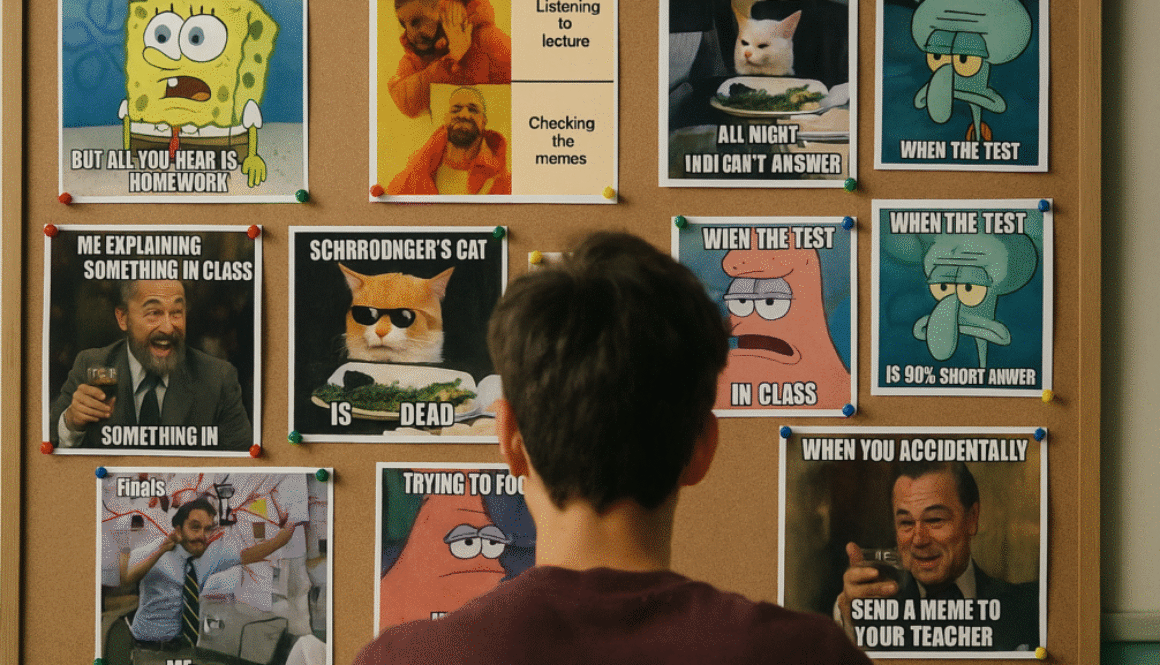
Even better, memes make boring concepts digestible. For example, Schrödinger’s cat: quantum mechanics’ favourite feline makes more sense when it’s wearing sunglasses and quoting Drake. Suddenly, quantum indeterminacy isn’t terrifying, it’s vibey. And that’s not just fluff. Memes use metaphor, satire, and humour to twist abstract concepts into relatable content (Marwick, 2013). They deconstruct the “big scary topics” into bite-sized nuggets. Think TikTok duets for your neurons.
According to Nicolescu(2016), memes are socially driven—they mirror values like beauty, kindness, and even intellectual aspirations. Pretty unexpected for something we usually just laugh at, isn’t it. So, memes don’t just teach—they connect. A meme about procrastination during finals week? That’s not just content, that’s community. More than that, memes allow students to reflect on their cultural and educational experiences through humour and satire. They give learners the power to own their interpretations of classroom content, flipping the traditional top-down teaching model into something a bit more… scrollable.
But first, let’s discuss some limitations before you start using SpongeBob screenshots to replace your entire syllabus.
Slater (n.d.) warns that memes aren’t universal. They rely largely on cultural cues, background information, and context. In one class, a meme that is popular might not be as successful as a group project in another.. Worse, without a solid grounding in the topic, a meme might oversimplify or misrepresent the concept entirely (Blackmore et al., 2000). That’s how misinformation spreads—and suddenly your bio class thinks mitochondria are just “the vibe factory.”
So, memes can’t carry the entire weight of education. But when paired with traditional methods, they’re the perfect sidekick—think Robin to your Batman, not the whole Justice League.
So… should we start grading memes? Honestly? Maybe. Why not let students meme their study guides? Ask them to remix historical events, scientific theories, or literary symbols into meme formats. Let them capture complex emotions through Squidward, or summarize entire novels using a perfectly timed SpongeBob screencap. It sounds unconventional, sure—but the act of creating a meme actually requires synthesis, understanding, and a solid grasp of the subject. That’s not cheating, that’s learning 2.0. And the best part? It’s fun. Like, actually fun. Education should feel engaging, not like a three-hour lecture delivered in monotone through a half-functioning mic. Memes offer students a voice, a creative outlet, and a way to connect course content to the real world, and to each other.
In a world where attention spans are short and content is everywhere, the ability to cut through the noise and make a concept memorable is a superpower. Memes do just that. They spark curiosity, trigger reflection, and sometimes, even change how we see a topic altogether. So yes, bring on the SpongeBob summaries and sarcastic takes on Shakespeare. Because if students are laughing and learning, something’s clearly working.
References
Blackmore, S., Dawkins, R., Dennett, D., & Brodie, R. (2000). The meme machine. Oxford University Press.
Honeyford, M. A., & Boyd, K. (2015). Learning through ‘making’ in a digital storytelling workshop. Pedagogies: An International Journal, 10(1), 62–80. https://doi.org/10.1080/1554480X.2014.999775
Marwick, A. E. (2013). Status update: Celebrity, publicity, and branding in the social media age. Yale University Press.
Nicolescu, R. (2016). Social media and the transformation of public space. Routledge.
Slater, D. (n.d.). Understanding digital cultures. Retrieved from https://www.digitalsociology.org/understanding-digital-cultures