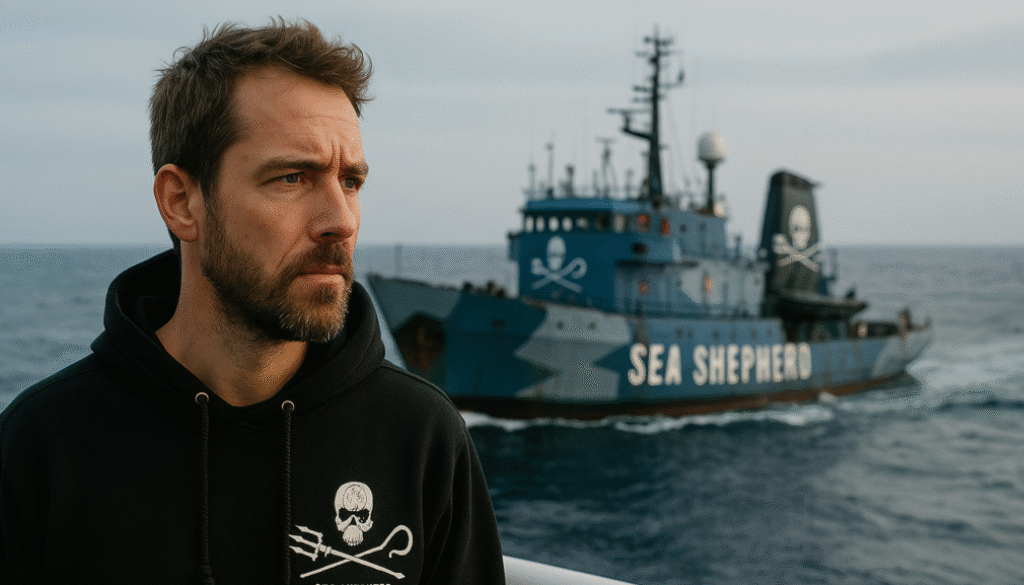
Have you ever heard of the Sea Shepherds?
Not many have. They’re not a state navy or some covert environmental agency, but they operate in the most lawless parts of the planet: The high seas—chasing illegal fishing vessels, confronting poachers, and taking marine conservation into their own hands. For most people, they exist far beneath the radar, operating in a world that is rarely visible and even more rarely understood.
I first came across their story while studying materials from a course manual, first while reading The Outlaw Ocean by Ian Urbina, and then through a hard-hitting documentary called Seaspiracy on Netflix. Both peeled back the curtain on the shadowy world of ocean crime and exposed the audacious, divisive strategies of organizations such as Sea Shepherd. What struck me wasn’t only what they do, but also their very existence and the lack of public recognition for their work really got to me. Because let’s face it: what happens in international waters is largely out of sight and out of mind. Organizations like Sea Shepherd have filled this enforcement gap by trying to patrol the oceans in ways that governments frequently aren’t able to or choose not to. But this bold approach raises questions. Who granted them the authority to enforce the law? Are they acting legally? What is the relationship between this and international frameworks as well as Indian maritime law, which is more active in protecting our own waters? The intriguing, contentious world of Sea Shepherd and the surrounding legal landscape are explored in depth in this article.
We must look beyond the news and into the field of international law to comprehend what gives Sea Shepherd its sense of authority. Because Sea Shepherd doesn’t operate completely outside the law, even though it isn’t a government agency. The organization claims it operates within a very specific and often overlooked legal space that allows, and arguably demands action when nation-states fall short. The United Nations Convention on the Law of the Sea (UNCLOS, 1982) is where their legal basis starts. UNCLOS, which is frequently referred to as the “constitution of the oceans,” establishes regulations for everything from deep-sea mining to territorial waters. Crucially, it also gives every country the authority to take action against certain crimes and piracy in international waters. According to Sea Shepherd, this gives governments and civil society the go-ahead to intervene when illicit activities endanger ocean ecosystems and there is no sign of official enforcement (United Nations, 1982).
But that’s just the beginning. Sea Shepherd also makes use of the International Whaling Commission’s (IWC) 1986 ban on commercial whaling. Sea Shepherd views its actions, pursuing and interfering with these operations as a form of enforcement on behalf of the international community when Japanese fleets continue to hunt whales under the pretence of scientific research (International Whaling Commission, 1986).Then there’s CITES—the Convention on International Trade in Endangered Species of Wild Fauna and Flora which prohibits the trade of various marine species at risk of extinction. Sea Shepherd uses this to justify missions against shark finning, the illegal bycatch trade, and other harmful practices targeting protected wildlife (CITES, 1975).
In their eyes, these treaties aren’t just policy documents. They are moral and legal obligations—ones that civil actors must uphold when governments look away. Sea Shepherd argues that in the lawless and often neglected high seas, doing nothing is a worse violation than stepping in. Yet this philosophy places them in a legal grey zone. They are hailed by their supporters as heroes for filling critical enforcement gaps in marine protection around the world. However, some, not only those in the fishing sector, see them as vigilantes who are crossing lines that belong to sovereign states.
And that conflict between legal ambiguity and moral necessity is what makes Sea Shepherd’s story so compelling—and crucial to analyse. But passion alone doesn’t grant legal immunity. Although Sea Shepherd argues that its operations are morally required and supported by international law, courts and legal experts have frequently disagreed and not always without repercussions. One of the most significant moments in Sea Shepherd’s legal history came in 2013, when the U.S. Ninth Circuit Court handed down a harsh judgment: it ruled that some of the organization’s high-seas tactics, like ramming ships or throwing foul-smelling butyric acid onto decks could be considered piracy under international law (Institute of Cetacean Research v. Sea Shepherd, 2013). Yes, piracy. The very crime Sea Shepherd claimed to fighting. This wasn’t just legal semantics. Under UNCLOS, piracy is defined broadly—not only as robbery at sea, but also as “illegal acts of violence or detention for private ends by the crew of a private ship” (Nagtzaam & Guilfoyle, 2018). And because Sea Shepherd is not a state actor, and its actions involved physical confrontation without formal authorization, the court held that even acts done for environmental protection could fall into this category.
It was a turning point, one that forced Sea Shepherd to reflect and evolve. And evolve they did. Sea Shepherd started to change course after realizing the legal ramifications of acting without official support. The group has shifted in recent years toward collaborations with coastal states, especially in West Africa, where illicit fishing is common and local law enforcement capabilities are weak. Now, instead of unilaterally boarding ships under a Sea Shepherd flag, their crews work directly with national navies and fisheries departments. They supply boats, intelligence, and trained personnel while the legal authority comes from the state. This shift has been transformative. Sea Shepherd has obtained legal legitimacy by functioning under government jurisdiction, which enables them to board, examine, and even detain vessels suspected of breaking marine laws, this time with the full support of sovereign governments. It’s a strategic compromise: they give up their extreme independence for the legal shield that state partnership provides. However, in doing so, they have discovered a new equilibrium that harmonizes the authority of the law with the moral imperative. And perhaps, in today’s complex global ocean, that kind of evolution isn’t just tactical. It’s necessary.
All of this naturally made me wonder: what about us? What’s India’s stance in this growing conversation about maritime enforcement? Do we rely on non-state actors to keep our waters safe, or we have mechanisms of our own to take charge? As it turns out, India isn’t just participating. It’s stepping up in serious ways, with its advantageous location in the centre of the Indian Ocean, India has started to take more active control of its maritime territory. Additionally, the Maritime Anti-Piracy Act of 2022 was a significant advancement. This policy change is more than just a token. It clearly criminalizes piracy, gives Indian naval forces extraterritorial jurisdiction (the ability to act even in international waters), and expands India’s legal reach beyond its territorial seas. Offenders may now be sentenced to life in prison or even death in extreme circumstances (Maritime Anti-Piracy Act, 2022). There is more to this legislation than meets the eye. It is made to comply with UNCLOS, demonstrating India’s adherence to global maritime norms. More significantly, though, it demonstrates that India is no longer willing to stand by and watch as ocean crime persists. It’s taking charge.
Another cornerstone of our maritime enforcement is the Indian Coast Guard Act, 1978. This Act gives the Coast Guard authority within India’s Exclusive Economic Zone (EEZ), a 200-nautical-mile stretch where India has rights over marine resources. Within this zone, the Coast Guard is empowered to stop illegal fishing, smuggling, and even marine pollution. In essence, it acts as the first line of defence against activities that organizations like Sea Shepherd elsewhere in the world would usually attempt to disrupt.
And this isn’t just legislative paperwork—it’s playing out in real time. Just in 2024, the Indian Navy carried out several high-stakes operations. Dozens of hijacked merchant vessels were rescued, and over 30 pirates were arrested and prosecuted under the new anti-piracy law (Reuters, 2024). These missions were concrete examples of a state actively regaining its maritime sovereignty and lessening its dependency on non-state or external enforcement; they were not merely symbolic.
However, India’s emphasis on regional cooperation is arguably one of its most progressive features. India leads the Information Fusion Centre – Indian Ocean Region (IFC-IOR), a multilateral intelligence-sharing hub that coordinates maritime threat responses with over 20 partner nations. This initiative allows real-time tracking of suspicious vessels, piracy threats, and environmental violations. In short, it’s India’s answer to the enforcement vacuum that Sea Shepherd stepped into elsewhere, except it’s institutional, coordinated, and state-led.
So, while Sea Shepherd may still be crucial in certain parts of the world where governance is weak or compromised, India’s example shows what it looks like when a nation builds strong, internal mechanisms to protect its marine territory—legally, effectively, and sustainably. And maybe that’s the larger point here.
But let’s bring it home. What if Sea Shepherd wanted to operate in Indian waters—say, off the coast of Tamil Nadu or in the Andaman Sea? Could they intervene against illegal trawlers or enforce bans on endangered species trade the way they do in West Africa?
Legally the answer is no—at least not unilaterally. Sea Shepherd would require official permission from the Indian government in order to carry out any operations in Indian territorial waters or within the Exclusive Economic Zone (EEZ). Any direct action, like getting on fishing boats or stopping suspected poachers, would still be a violation of Indian sovereignty without such support. Regardless of the environmental motivation, such actions may even be prosecuted as criminal obstruction or piracy under the Maritime Anti-Piracy Act, 2022. But that doesn’t mean the door is entirely closed. There is room for collaboration and meaningful precedent for it. Given India’s growing commitment to marine conservation, partnerships could be designed under joint frameworks. In such models, Sea Shepherd could serve as a logistical ally, providing surveillance, vessels, and personnel, while Indian authorities retain legal command and operational control. This isn’t hypothetical; this is already happening in places like Gabon, Liberia, and São Tomé and Príncipe, where Sea Shepherd patrols under the official direction of national navies. For India, this could be a force multiplier. It doesn’t imply outsourcing law enforcement, but rather, enhancing capacity while preserving command and legal clarity. In areas where coast guard presence is stretched or where persistent violations occur, NGOs could serve as the eyes and ears without compromising on legal sovereignty.
Of course, India doesn’t need Sea Shepherd to guard its waters. Its legal framework is robust, its naval force growing, and its institutional coordination like the IFC-IOR is already world-class. But as climate change accelerates marine degradation and illegal fishing networks grow more sophisticated, smart, lawful collaboration may become not just useful but necessary. Beneath the waves, beyond national borders, and outside the usual reach of law, the ocean tells a story of power, neglect, and resistance. And few embody that resistance like Sea Shepherd. Their story as vividly illustrated in The Outlaw Ocean and Seaspiracy, lays bare a difficult reality: the sea, for all its vastness, remains one of the last truly lawless frontiers. Their risky, confrontational missions were born out of a tangible emptiness rather than just idealism. Ecosystems suffered as a result of governments’ blindness. However, one thing is evident even in these periods of lawlessness: good intentions do not take the place of legitimate authority. Furthermore, without state recognition, even the most fervent interventions may begin to resemble the very lawlessness they are meant to combat.
As the legal and geopolitical environment shifts, a new approach is becoming more popular. One that does not minimize the urgency of civil action, but rather takes it into account. Where the moral clarity of groups like Sea Shepherd aligns with the legal command of sovereign states. It’s not a perfect system. But in a world where oceans suffer more from inaction than interference, this evolving model of cooperative enforcement may be our most pragmatic and promising path forward.
References
CITES. (1975). Convention on International Trade in Endangered Species of Wild Fauna and Flora. https://cites.org/eng/disc/text.php
International Whaling Commission. (1986). International convention for the regulation of whaling, 1946: Schedule. https://iwc.int/document_1
Institute of Cetacean Research v. Sea Shepherd, 708 F.3d 1099 (9th Cir. 2013).
Maritime Anti-Piracy Act, No. 22 of 2022, Gazette of India (2022). https://egazette.nic.in
Nagtzaam, G., & Guilfoyle, D. (2018). Legal perspectives on environmental activism at sea: The case of the Sea Shepherd Conservation Society. In G. Nagtzaam (Ed.), From environmental to ecological law (pp. 201–225). Routledge. https://doi.org/10.4324/9780429454233
Reuters. (2024, April 10). Indian Navy arrests over 30 pirates in major Indian Ocean operation. https://www.reuters.com/world/india/indian-navy-piracy-crackdown-2024-04-10/
United Nations. (1982). United Nations Convention on the Law of the Sea. https://www.un.org/depts/los/convention_agreements/texts/unclos/unclos_e.pdf
Urbina, I. (2019). The outlaw ocean: Journeys across the last untamed frontier. Alfred A. Knopf.
Seaspiracy. (2021). [Documentary]. Directed by A. Tabrizi. A Netflix Original Documentary. https://www.netflix.com/title/81014008