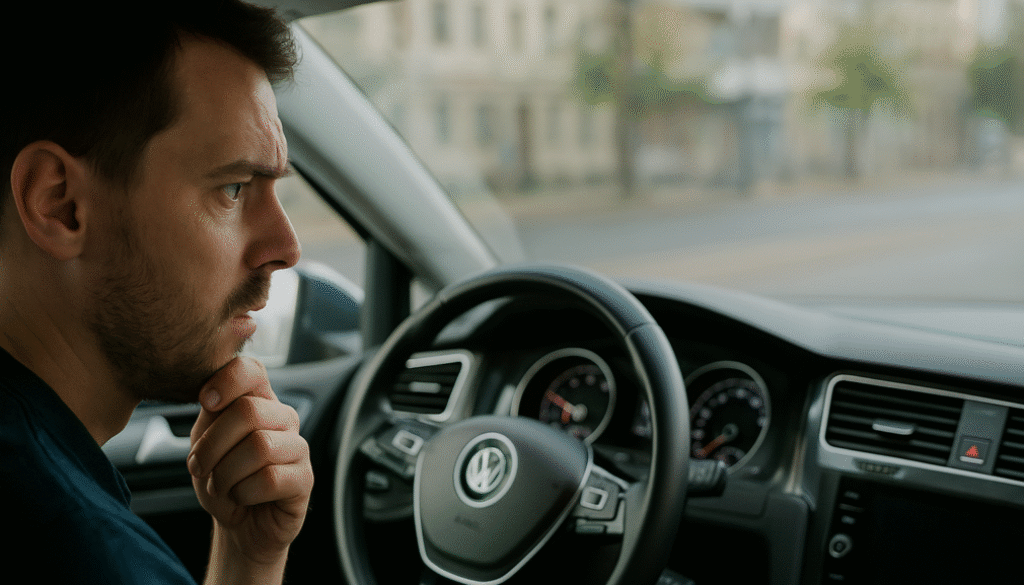
Ever thought your car might be lying to you?
That was the question that stuck with me when I read Chapter 5 of Clearing the Air by T. Smedley as part of my coursework. What I expected to be a standard commentary on vehicle emissions turned out to be a jaw-dropping exposé of one of the most calculated corporate scandals in recent memory: Volkswagen’s Dieselgate. The chapter wasn’t just some technical breakdown of engine flaws, it pulled back the curtain on a global deception. Cars weren’t simply underperforming; they were rigged to trick the very systems meant to hold them accountable. And the more I read, the more it became clear that this wasn’t just a problem for Germany or the U.S. It was much bigger than that. Courtrooms and parliaments around the world, including right here in India, were affected by the revelations, which led to heated discussions and significant policy changes that still influence how we control the air we breathe.
For years, Volkswagen marketed its diesel vehicles as cleaner, greener, and more efficient alternatives to petrol cars. Buyers across Europe and the United States were reassured by emissions ratings that met the strictest standards. But behind that green image, something far less eco-friendly was brewing. What the company had actually done was install a “defeat device”. A clever bit of software that could detect when the car was undergoing an official lab emissions test. During testing, the engine would switch to a low-emissions mode. Out on the road, where real driving happens, the same engine would revert to full performance, emitting up to 40 times the legal limit of nitrogen oxides (EPA, 2015).
It’s easy to ask: how could something like this go unnoticed for so long? The truth is, emissions testing regimes were largely built on the assumption that manufacturers would comply in good faith. Volkswagen exploited that assumption with devastating precision. And it wasn’t just an ethical failure, it was a legal one. Under the U.S. Clean Air Act, tampering with emissions control systems is a federal offense. European laws under Regulation (EC) No. 715/2007 also prohibit such defeat devices, yet millions of vehicles had already been sold by the time regulators caught on. There was a huge fallout. In the end, Volkswagen acknowledged its wrongdoing and settled over $33 billion in fines, car recalls, and environmental cleanup (Reuters, 2015).
The company’s once unquestionable reputation was permanently damaged, and senior executives faced criminal charges. Dieselgate is noteworthy not only because a large corporation violated the law, but also because it demonstrated how ill-equipped and brittle our legal systems, the very ones designed to safeguard our health and the air we breathe were.
Now, you might be wondering, what does this mean for India? After all, most of the headlines came out of the U.S. and Europe. But the ripple effects reached Indian shores, and quickly. When the scandal broke, the Automotive Research Association of India (ARAI) conducted its own investigation and found that Volkswagen’s diesel cars were emitting pollutants far beyond Bharat Stage IV (BS-IV) norms. The case quickly made its way to the National Green Tribunal (NGT), which gave it prompt attention. In a startling ruling, the NGT fined Volkswagen ₹100 crore for environmental harm and public health effects, which was later increased to ₹171 crore (DownToEarth, 2018).
What made this ruling hit harder wasn’t just the hefty fine. It was the reasoning behind it. The tribunal leaned on the ‘polluter pays’ principle, deeply woven into India’s environmental laws, and anchored its decision in something far more personal: Article 21 of the Constitution: The right to life itself. It wasn’t just a corporate violation; it was an assault on the air that millions of Indians breathe. In this way, the legal response in India echoed a global shift: from seeing air pollution as a regulatory nuisance to treating it as a rights-based crisis. Policy reform was one of Dieselgate’s most enduring effects in India. Vehicle emission regulations had developed gradually and unevenly up until that point. However, the Indian government made the audacious and nearly unprecedented decision to move straight from BS-IV to BS-VI standards in 2020, bypassing the intermediate Bharat Stage V. These new regulations align closely with European standards and represent a dramatic tightening of permissible emissions across the board (JusCorpus, 2023). Suddenly, the auto industry had to respond to both legal pressure and public expectation not just with cleaner technology, but with transparency.
Still, a lingering question remains: What initially made Dieselgate possible? The intention behind the technology was the issue, not the technology itself. Volkswagen chose to innovate in the wrong direction, but it didn’t fail to innovate at all. And that’s where morality and the law meet. Because we are dealing with a breach of public trust rather than a technical issue when a company uses its engineering expertise to manipulate regulations rather than to protect the environment. The scandal also serves as a sobering reminder that legal systems must evolve as fast as the technologies they aim to regulate.
Dieselgate didn’t just reshape automotive policy; it reframed the conversation around environmental law. It taught us that the price of law enforcement’s failure to keep pace with corporate ambition is not measured in spreadsheets but rather in lives lost. If there is one lesson to be learned, it is that clean air is more than just a regulatory metric. It’s a right. Like all rights, it must be continuously protected from deceit as well as pollution.
References
Down To Earth. (2018, March 7). Volkswagen to deposit Rs 100 crore with CPCB: NGT. https://www.downtoearth.org.in/news/air/volkswagen-to-deposit-rs-100-crore-with-cpcb-ngt-59806
Environmental Protection Agency. (2015, September 18). EPA, California notify Volkswagen of Clean Air Act violations. United States Environmental Protection Agency. https://www.epa.gov/enforcement/epa-california-notify-volkswagen-clean-air-act-violations
JusCorpus. (2023, March 1). The Volkswagen emissions scandal and its implications on Indian environmental law. https://www.juscorpus.com/the-volkswagen-emissions-scandal-and-its-implications-on-indian-environmental-law/
Reuters. (2015, October 1). Volkswagen scandal: Timeline of events. https://www.reuters.com/article/us-volkswagen-emissions-timeline-idUSKCN0RV4AO20151001
Smedley, T. (2019). Clearing the air: The beginning and the end of air pollution. Bloomsbury Publishing.
Regulation (EC) No 715/2007 of the European Parliament and of the Council of 20 June 2007 on type approval of motor vehicles with respect to emissions from light passenger and commercial vehicles (Euro 5 and Euro 6) and on access to vehicle repair and maintenance information. Official Journal of the European Union, L 171, 1–16. https://eur-lex.europa.eu/legal-content/EN/TXT/?uri=CELEX%3A32007R0715