Case Analysis: Arjuna Killing Karṇa While He Was
Unarmed on Krishna’s Command
Introduction
The Mahābhārata presents complex situations where the boundaries between Dharma and
Adharma blur, especially during war. One of the most debated incidents is Arjuna killing Karṇa
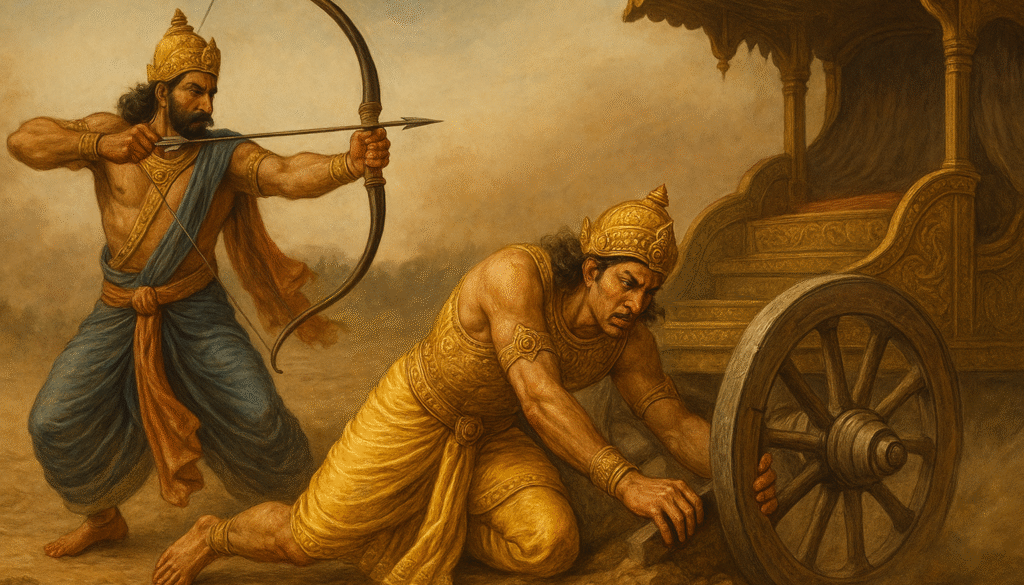
when he was weaponless and attempting to lift his chariot wheel during the Kurukshetra battle.
The situation explicitly states that Karṇa was unarmed (nirāyudham) and that the act appeared
similar to Adharma. By virtue of this situation, I want to raise a fundamental question about
dharma itself, on which I have been pondering since a long time.
Facts of the Incident
During the war, Karṇa’s chariot wheel sank into the ground. Bound by the rules of Dharma-
Yuddha, he requested Arjuna to pause the battle until he could arm himself again. However,
encouraged by Krishna, Arjuna shot a lethal arrow, killing Karṇa while he was defenseless.
Mahabharata acknowledges that the act appeared to be Adharma because killing an unarmed
warrior violated established codes of war. Yet Krishna justified the action by arguing that
Karṇa himself had violated Dharma multiple times in the past, especially during the disrobing
of Draupadī, gambling with the Pandavas and the collective, ruthless killing of Abhimanyu.
1. तचतु राधेयः ◌ोधादूयवतयत ् । अजुनं वीय संरधमदं वचनमवीत ् । ।१०७ । ।
पहया फ ँ स जानेके कारण राधापु कण ◌ोधसे आँसू बहाने लगा और रोषावेशसे यु अजुनक ओर देखकर इस
कार बोला— । ।१०७ । ।
भो भोः पाथ महेवास मुत परपालय । यावचमदं तमुराम मह=तलात ् । ।१०८ । ।
‘महाधनुधर क ु तीक ु मार! दो घड़ी तीा करो, जससे म इस फ ँ से ए पहयेको पृवीतलसे नकाल लूँ । ।१०८ । ।
2. ततः कर=ट तलय सं◌ा◌ं जाह बाणं यमदडकपम ् । ।३२ । । ततोऽजुनः ◌ालकं महामा ततोऽवीद वासुद ◌्
◌ेवोऽप पाथम ् । छयय मूधानमरेः शरेण न यावदारोहत वै रथं वृषः । ।३३ । ।
इसी समय होशम आकर करOटधारO महामा अजुनने यमदडके समान भयंकर आंजलक नामक बाण हाथम
लया। यह देख भगवान ् ◌ीक ृ णने भी अजुनसे कहा —‘पाथ! कण जबतक रथपर नह चढ़ जाता तबतक हO
अपने बाणके ◌ारा इस शुका मतक काट डालो’ । ।
Arjun then proceeds to release an arrow that cuts Karna’s head off while he is lifting the wheel
of his chariot, beheading him and finally killing him. Karna’s head falls to the earth like the red sun setting behind the western mountain, and his body, pierced and blood soaked, collapses like a mountain peak struck down. Karna’s inner brilliance or “tejas” is described as rising from his body and merging into the solar orb, linking
him symbolically back to Surya, his divine father.
Issue
Whether Arjuna’s killing of an unarmed Karṇa constitutes Adharma, or whether thecontextual circumstances justify the act as a form of higher Dharma. If so, does Krishna
have the right to interpret Dharma as that?
Dharma (Definition)
The term dharma derives from the Sanskrit root “dhr ̥ “, which means “to support, hold, or bear”.It is the thing that regulates the course of change by not participating in change, but that
principle which remains constant.
In common parlance, dharma means “right way of living” and “path of rightness”.
Basically, Dharma is a moral compass which has fixed directions, and the directions should
ideally only lead to a path that is right. By its nature it is not something that is interpreted, it
just is. It exists as it is. And following that logic, actions can be categorized in two parts, dharma or adharma relatively objectively.
Analysis
To answer the issue, whether Arjun’s beheading of Karna constitutes adharma or if it was anact justified by “higher dharma”, before we argue that it is impertinent to first argue if dharma,
by its definition is flexible or not.
Rajadharma which is a philosophy that emphasises that Dharma is supreme, even in the
presence of a king. It says that, king is only an enforcer of dharma instead of a conventionally
assumed sovereign with his own powers to decide matters, this according to me is also the
differentiating factor between rule of dharma as described by the ancient Indian texts and
traditional monarchical rule.
The very essence of rule of dharma is that no one is above it and it is the “righteous duty of
oneself”. It then frankly pains me, to see that, Krishna time and time again takes dharma into
his own hands (it matters not if what he was saying was ethically right of not) but only the fact
that that dharma is left open to interpretation and Krishna’s interpretation of it is right because
he is a “god” and what he says “must be right”. What this simply implies is the “differentiating factor” stops existing; “god” acts as “king” does in other philosophies, leaving dharma no more unique than any other ideology.
Conclusion
Arjuna’s killing of Karna is then, by dharma’s definition, neither dharma nor adharma becausehe has to do what he has to do, given, it was guided by his own moral compass; which it was
not because he was not able to contemplate it himself.
Practically, it was just the influence of Krishna’s words and his own personal opinions, because
that is what they were, guiding Arjuna to finally release the killing blow. This is awfully similar
to how a king commands his soldier to kill his enemies.
My analysis does not intend to critique Krishna’s actions or their morality, but the very core
divine justification of that adherence seems hypocritical to me and puts principle of dharma to
shame as it the very beauty of dharma that one must contemplate his own actions himself and
learn from them, even if they bear consequences as resulting from adharma.